

In his lifetime and in the decades after his death, Heinrich Isaac (c.1450-1517) was the most printed and written-about composer in Europe. Later centuries reduced him to a footnote in discussions of that era. Recently, however, Isaac’s importance has undergone renewed scrutiny as new studies have shed light on his reputation as a musician of unique and ground-breaking status.
Born in the Netherlands sometime around 1445, Isaac was in the employ of Duke Sigismund of Tyrol by the early 1470s. His activity there brought him to the attention of Lorenzo (il Magnifico) de Medici, Florence’s “first citizen”. Isaac must have had a substantial reputation by then, since Lorenzo employed him to Florence in 1485. At the zenith of their wealth and power- the Medici were accustomed to surrounding themselves with the finest talents in music, art, and literature. Isaac, while officially in the employ of several Florentine church institutions financed by the Medici, he was brought to Florence to be the musical counterpart to other figures in the Florentine mainstream such as da Vinci, Botticelli, Machiavelli, and the young Michelangelo. He tutored the Medici children (one of whom became Pope Leo X) and contributed to the Florentine musical scene, laying the groundwork for the early madrigal.
Different from most of the musical northerners from Franco-Flemish lands that came to work in Italy Isaac 1) was not a priest and 2) married a Florentine woman, became a citizen, and made Italy his home rather than go back north to retire.
Lorenzo died in 1492 and Florence was taken over by the fanatic monk Savonarola. Isaac, who evidently was able to get along with anyone, remained in Florence despite certainly having some of his compositions consumed in the Bonfire of the Vanities. But, in 1497, Isaac accepted an appointment as court composer (Hofkomponist) for the Habsburg Holy Roman Emperor Maximilian I. Unique in this agreement between Isaac and Maximilian is the esteem with which Isaac was held. Maximilian sought Isaac out, not the other way around, and, unthinkable at the time and for many years to come, Isaac was not required to reside at Maximilian’s court. Rather, he continued to live in Florence as Maximilian’s diplomatic representative and made occasional trips to meet with Maximilian’s court.
Wegman (2011) points out that Isaac is the first musician to be labeled a “composer” in any official documents, in a time when most composers were hired as singers or instrumentalists or held holy orders as priests.
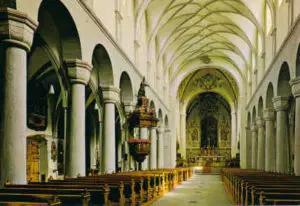
In 1507, Maximilian convened the Reichstag – the parliament of the Empire, nobility, major churchmen, and other leaders – in Constance, Germany. Isaac traveled to Constance from Florence to provide music for the combined forces of Maximilian’s Imperial Hofkapelle (court chapel choir) and the Constance Kantorei (cathedral choir), described by Schuler (1980) as “one of the leading pre-Reformation vocal groups in Germany”.
During Isaac’s two-year stay in Constance, he was commissioned by the Constance cathedral chapter to “compose a group of motets, setting in choral polyphony certain portions of the Mass Proper to the most solemn feasts of the liturgical year”. One of the stipulations of the commission was that the music would remain the property of the Constance cathedral, not to be printed or shared elsewhere. Isaac completed this commission and submitted a set of motets to the cathedral on November 29, 1509. It is yet unclear as to whether he was still in Constance at that date or whether they were submitted from somewhere else. Isaac was active as a Florentine citizen after the Constance commission as documented by Zanovello (2008) and others.
Alas, history did not favor this collection of sacred music. In the same year as Isaac’s death, Martin Luther sent the 95 Theses to the Archbishop of Mainz. The resulting religious upheaval spread quickly and by 1520 the Reformation arrived in Constance. The citizenry revolted against the Prince-Bishop, ruler of the city. He was forced to flee across Lake Constance to set up residence in Überlingen and, while some of the musicians of the cathedral remained, others joined the Reformation effort or left for other places. The Isaac manuscripts went various ways and other music liturgical books were lost, such as the Constance missal containing the chants upon which Isaac’s music was based. Maximilian died in 1519. His successor, Charles V of Spain assumed the throne and brought his own musicians with him, disbanding the Hofkapelle that Maximilian had assembled and for which Isaac had composed a multitude of sacred polyphony.
The story of how the Isaac manuscripts from Constance and the Imperial repertory came to be printed as one compilation is interesting and convoluted. Burn (2002) provides a detailed summary. In short, a Nuremberg bookseller, Johannes Ott, announced in 1537 that he intended to publish the “Choralis of Constance”. He had evidently compiled quite the collection of Isaac motets for the Mass Proper from various sources, including Ludwig Senfl, who had been part of Maximilian’s Hofkapelle and who probably had much of the former Imperial repertory in his possession. But, both Ott and Senfl died before this collection was ever published. Ott’s printer, Hieronymus Formschneider, evidently bought or was given the manuscripts by Ott’s widow and Formschneider eventually published the music in three separate volumes in partbook format under the title Choralis Constantinus (CC). The first volume appeared in 1550 with volumes two and three following in 1555.
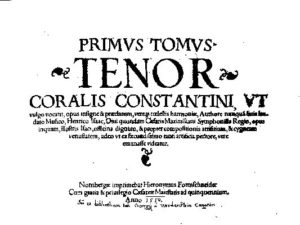
Shortly after Formschneider’s publication, however, the reforming Council of Trent made much of the music liturgically obsolete. The Choralis Constantinus became the domain of theorists and musicologists, who wrote many treatises throughout the centuries regarding Isaac’s remarkable plainsong-based polyphony. The collection was under continual study and not forgotten, but little performed. Indeed, Anton Webern, one of the most influential composers of the twentieth century, transcribed Volume II of the Choralis Constantinus as his doctoral dissertation at the University of Vienna.
For more information regarding Isaac and his legacy, do not look to music history books. Instead, peruse the selected references.